On Change: Just Do It—Or Don’t?
Stop fearing and over-thinking and commit instead.
In my recent writing on leaving the American tech ecosystem—or at least much of it—I saw a familiar strain from my other writing as well as life experiences.
I came to think of how incredibly common it is to find people completely absorbed in their ways, manners, ideas, and doings, often without (seemingly) reflecting at all about these things—that they take as absolute, true and evidential of who they are—and how hard change is for so many.
You see this in how people cling to beliefs like “we cannot leave Microsoft”, or “we need X to run a business”, “I need a car”, “I have to exercise at the gym”, or “I need to eat butter popcorn 4 times a day”. Some things more obscure than the other, but problematically, there are many uninspected or at least poorly constructed beliefs. None of them are completely (or at all!) true, but more importantly, most of them are only at best contextually semi-true. “Change” changes the picture and thus the context.
What if you ran your business only on paper and pen? Or a restaurant like an informal shop in Ethiopia? Or you worked remotely? Or you integrated training into your everyday movement patterns? There is no shortage of options, and thus, of “change” possibilities.
With “change” I broadly mean those breaking events that we humans experience in life. As you may have noticed, humans are one of few animals to actively make choices on how we play out our lives on a high level. We can experience both unwanted change, such as losing our job for external reasons, as well as actively seek change, such as when we want to quit smoking, start playing the guitar, or exercise more. Workplaces and all non-trivial social contexts are entirely predicated not just on the interactions between people and technology and processes, but also how change is introduced to steer that flow of interactions. As everyone knows, a bad workplace will have overwhelming energies driving negative change (or even outright stagnation).
Change is a major part of being a human, not just “receiving” or accepting change inflicted on you, but also as the moment of actual, enacted agency. Without change—and in effect, no enacted agency—you are forfeiting the greatest power we humans have been bestowed with. If you don’t change, and I’ll be deliberately spicy here, I think you’re not living in the wider, philosophical sense. He who is permanently the same has not lived.
To change is (often) to learn. If not directly, then indirectly, since change forces you into unfamiliar territory.
We seek change to improve our conditions, try something new, become more of what our hearts and minds are pulling us toward. Change is what it means to be human. Learning and discomfort is the price we pay for it.
From my teaching days I recollect clearly that learning is hard and not very fun at all, much of the time, no matter if you are 17 or 30 or any other age. I see this same thing being a parent: kids don’t necessarily always enjoy learning. And neither do I!
The hundreds or even thousands of times I’ve done sweep picking runs or played the weirdly-difficult intro solo in Metallica’s For Whom The Bell Tolls (at the right tempo and swing/timing) should have driven me crazy, except it didn't. I had to accept that, yes, I can play the guitar just fine for some stuff, but not this specific piece. I’ve got to embrace the suck and just do it to get to that perfect timing. I’ve failed and struggled and done the hours so many times, in so many other contexts, that I know I’ll get out eventually. But is it fun when you are knee-deep in the pain zone? Often the answer is “no”. But that is not enough to stop me, or anyone else that ever learned to play an instrument, or do anything else that takes training and practice. Is it the ghost of complacency and laziness that makes us believe we can play like rock stars without spending the hours practicing?
Similarly, remembering the countless hours I spent prepping for the Google Professional Cloud Architect exam during a sweltering summer was not necessarily fun. Certainly, I learned a lot and it was a good move for my career. Without it I would have probably been at a different (worse?) place. But do we know this to be true? Life and our experiences and what we learn is not straight, known a priori, nor do we understand most of the downstream consequences of changes and choices we introduce.
With the risk of sounding obvious and melodramatic, change is the constant. But we know nothing about change as a consequence of our actions. However, we do see it in the present tense, as the actions forming the change itself.
I see the root of change rejection (my non-scientific, intuitively named term for actively not committing to change) as stemming from some degree of fear. I guess there’s someone out there who’d want to draw the line to Nietzsche and the will to power here, too, or herd mentality locking people down in their routines, but I digress. Generally, perhaps the fear could be located in the fear of the unknown, ergo, what happens naturally as the stochastic and unknowable effects of conducting that change—the parts we don’t control.
For unclear reasons, and something I wholeheartedly regret looking back at the first half (I hope!) of my life, is that I’ve read and skimmed too many pop-psychology and similar-genre-books to recall. The majority are effectively garbage. No matter if their research is good or not, the actual books (often 250+ pages) pad relatively simple ideas, which may well be interesting on their own, but they become vapid at book-length scales. In writing this I recall specifically Atomic Habits as one of these books. I mention it to call how the pop-psych and self-help books make you consume the desire to change, rather than do it. You don’t need a fucking book to change. Just do it.
Nike already encapsulated my message, though I’ll take the opportunity to improve it:
Just do it. Or don’t.
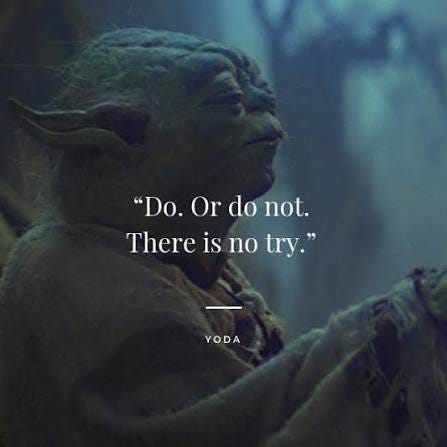
Hell, even Yoda got it right.
I think it was guitarist Ben Eller who said something along the lines of “if you get a guitar and you play it, you are a guitarist”. Simple as that.
You are what you do, and consequently, are not what you don’t do. You are not a “keynote speaker” (regardless of what your LinkedIn profile bullshits about) for having done a talk three years ago. “Being” means committing and doing at some relatively regular cadence.
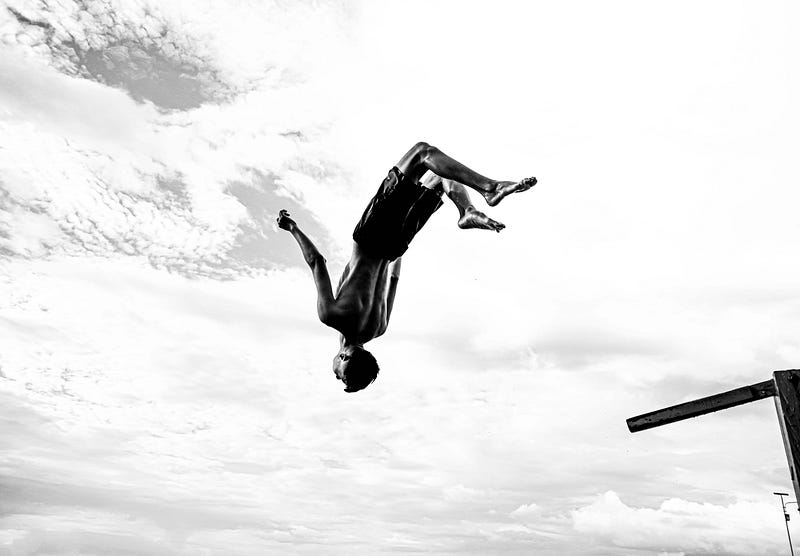
When I was a kid I was scared of so many things. Let me exemplify this for you: I was super scared of diving head-first into the public pool, for example; I found it extremely unnerving. Probably a valid reason, granted that throwing yourself literally headfirst into the “ground” does feel counter-intuitive. This fear was mostly overcome by just doing it. My strategy was to not think at all, just allow myself to disconnect my brain for a split second and perform the dive. As soon as gravity starts to work, I figured I was committed and there was no looking back. So I jumped, with some vain effort to a dive motion, into the pool. I survived, evidently, to tell the tale. So I continued doing it and had a blast that day. The fear subsided, at least for the time being. The bodily reaction (fear) was subjected to an experienced physical reality where this was not dangerous—in fact, it was pretty fun.
I grew up with an alcoholic parent. No matter the number of times there was promises of “I’ll change” that amounted, ultimately, to exactly zilch. The only valid change option is to stop drinking. I think Alcoholics Anonymous got that part right. I however do think you are not always an “alcoholic in-hiding”, like AA makes folks believe. Unlike AA, I do think you can kick the habit permanently and stop demonizing yourself over a period (no matter how long) of alcohol abuse. Regardless, the key piece here is that you stopped drinking problematically and committed to it. At some point this is the new normal. But you will always be an alcoholic if you keep drinking, no matter how refined your bullshit or embellished your cloak of intentions is.
Another example: For maybe 3–4 years, somewhere in the 2015–2017 era or so, I trained very regularly, like 6 days a week or something. This was, at the time, who I was. It was a major part of my then-identity. I would be writing training programs while taking a coffee at work and a lot of my friend circle was down playing the same game.
Then, for several reasons, including having our first child and switching up my career, I dropped all of that in a flash. Literally in a single day, like turning on a dime, I stopped all that and recalibrated my time, life, activities, and objectives. I’m definitely not sure those ex-friends liked that, but knowing myself, I really don’t like dawdling so I went full, instant cold turkey. This should serve as a fairly direct comparison to how I “just did it”, diving into the pool when I was a kid. You cut off the reflex that starts to overthink and just commit. You are now someone else.
That pattern repeats many times in my own life, and I’m sharing less for “copy this behavior” but more to demonstrate that it’s fully doable. Nothing holds you back if you are willing to enact true change. Even if it means cutting throats, burning bridges, or relocating. It’s all doable. You’ve just got to ask yourself who you are living for and why. You’ve already got your compass, right?
In our less and less real, sense-based, and physical reality—the new reality that Byung Chul-Han would call our “autistic” society of glass screens—I fear we forget that we are still good-old meat-sacks with senses and minds; that we are not just floating eyeballs that consume Youtube ads and casual Nazism on social media. It is fantastic that even if our society, as technology-obsessed as it is right now, is different today than when I grew up in the 90s, we are still human beings—even if that is becoming less and less apparent and realized in our lifestyles and daily existence.
What to do to rebel against a world of mental stagnation and social media bubbles? Be more human, change more often.